Design Goals
- Separate departments into their own VLANs
- Use trunk links correctly between network devices
- Enable inter-VLAN communication where needed
- Apply ACLs to control unnecessary access
- Verify connectivity with testing instead of assumptions
Networking Project
A segmented small-office network designed in Cisco Packet Tracer with VLANs, trunks, inter-VLAN routing, and access control validation through structured testing.
This project models a small business network that needs better organization, separation between departments, and more controlled communication across the environment. I used Cisco Packet Tracer to design the topology, assign VLANs, configure trunks, and enable communication between networks where appropriate.
The goal was not just to make devices ping each other. It was to show that I understand how segmentation, routing, and policy work together in a practical small-business environment.
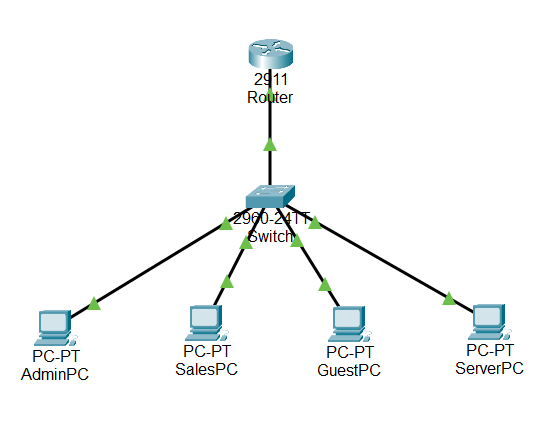
I configured VLAN assignments for the different user groups, set up trunk links so multiple VLANs could traverse shared connections, and used routing to allow communication between networks that needed it. From there, I tested the design to confirm that permitted traffic worked and restricted traffic was blocked where expected.
This project helped reinforce the relationship between Layer 2 segmentation and Layer 3 policy. It also gave me a better feel for how switchport roles, VLAN membership, and routing decisions affect end-user connectivity.
This project improved my understanding of segmentation, basic policy enforcement, and how to troubleshoot communication issues by checking the network in layers instead of guessing.